
示例:Devastator 坦克
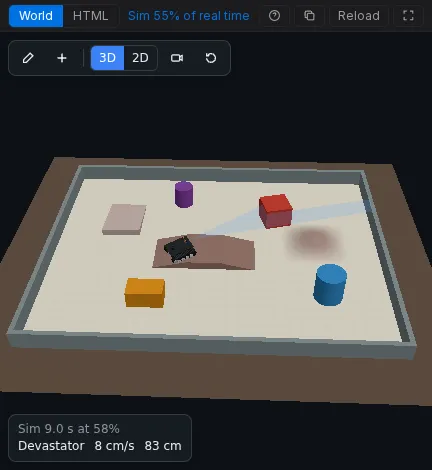
DFRobot Devastator 坦克搭载 Romeo BLE,运行 DFRobot 自带的避障示例。它向前行驶,直到舵机上的 URM37 读数小于 35 cm,然后左右张望,后退,并转向空间更大的一侧。World 是一个带有方形和圆形障碍物、一座桥、一座小山和一段坡道的场地,使用场景套件制作,因此你可以用鼠标编辑它。
打开它: velxio.dev/example/dfrobot-devastator-tank-avoidance 然后按 Run(运行)。
| Id | 零件 |
|---|---|
dfrobot-romeo-ble |
DFRobot Romeo BLE(板载两路电机通道) |
motorL, motorR |
带编码器的齿轮电机,45:1 |
servo1 |
转动声呐的舵机 |
urm37 |
DFRobot URM37 V5.0 超声波,PWM 模式 |
| 从 | 到(Romeo BLE) |
|---|---|
motorL M1 / M2 |
M1+ / M1- |
motorR M1 / M2 |
M2+ / M2- |
servo1 PWM / V+ / GND |
D10 / 5V / GND |
urm37 ECHO |
D8 |
urm37 TRIG (COMP/TRIG) |
D9 |
urm37 VCC / GND |
5V / GND |
该 sketch 是 DFRobot 为 Devastator 提供的示例(Avoidance_URM37.ino,作者
Gavin,2015),它包含的两个库 DFMobile 和 URM37 作为项目的文件。项目副本中只改了两处:行尾符,以及 include 使用引号,因为库文件与 sketch 放在一起。下面的清单缩短了 DFRobot 的注释。
#include "DFMobile.h"DFMobile Robot (4,5,7,6);   // left dir D4 / PWM D5, right dir D7 / PWM D6
#include<Servo.h>Servo myservo;
#include "URM37.h"ultrasonic URM37;double distance;int i=0;int distanceBuffer[3];
void setup(){  myservo.attach(10);  Robot.Direction(LOW,HIGH);   // (left direction, right direction)  Serial.begin (115200);  URM37.Init(8,9);             // ECHO on D8, COMP/TRIG on D9}
void loop(){  myservo.write(90);           // look ahead  Robot.Speed(80,80);          // forward  Measurement();
  if(distance < 35){    Robot.Speed (0,0);         // stop    myservo.write(0);          // look right    Measurement();    delay(200);    double degree_0 = distance;    delay(50);    myservo.write(180);        // look left    Measurement();    delay(200);    double degree_180 = distance;    delay(50);
    if(degree_0 > degree_180){      Robot.Speed(-200,-200);  // back off      delay(50);      Robot.Speed(200,-200);   // turn right      delay(200);    }    else{      Robot.Speed(-200,-200);  // back off      delay(50);      Robot.Speed(-200,200);   // turn left      delay(200);    }  }  else{    myservo.write(90);    Robot.Speed (100,100);     // forward  }}
void Measurement(){  distanceBuffer[i] = URM37.Distance();  i++;  if(i>2){    i=0;  }  // the largest of the last three readings  distance = distanceBuffer[0]>distanceBuffer[1] && distanceBuffer[0]>distanceBuffer[2]?distanceBuffer[0]:(distanceBuffer[1]>distanceBuffer[2]?distanceBuffer[1]:distanceBuffer[2]);  Serial.print(distance);  Serial.println (" cm");  delay (100);}
Robot.Direction(LOW, HIGH) 使两侧的“前进”方向电平都为 LOW,因为真实底盘安装电机时是镜像的。World 通过坦克两侧的 Reverse(invertLeft 和 invertRight)来体现这一点,因此 sketch 与 DFRobot 的版本完全一致。
场景(位于 world.html,可用 Edit(编辑)编辑):
{ "version": 1, "view": "3d", "floor": { "w": 3.0, "h": 2.4, "color": "#d8d2c4", "grid": true }, "objects": [ { "id": "wallN", "type": "wall", "x": 0, "y": 1.18, "rot": 0, "w": 3.0, "d": 0.04, "h": 0.15, "color": "#7f8c8d" }, { "id": "wallS", "type": "wall", "x": 0, "y": -1.18, "rot": 0, "w": 3.0, "d": 0.04, "h": 0.15, "color": "#7f8c8d" }, { "id": "wallE", "type": "wall", "x": 1.48, "y": 0, "rot": 90, "w": 2.32, "d": 0.04, "h": 0.15, "color": "#7f8c8d" }, { "id": "wallW", "type": "wall", "x": -1.48, "y": 0, "rot": 90, "w": 2.32, "d": 0.04, "h": 0.15, "color": "#7f8c8d" }, { "id": "box1", "type": "box", "x": 0.55, "y": 0.5, "rot": 15, "w": 0.25, "d": 0.25, "h": 0.2, "color": "#c0392b" }, { "id": "box2", "type": "box", "x": -0.55, "y": -0.65, "rot": 0, "w": 0.3, "d": 0.18, "h": 0.15, "color": "#d68910" }, { "id": "cyl1", "type": "cylinder", "x": 0.95, "y": -0.55, "r": 0.12, "h": 0.25, "color": "#2e86c1" }, { "id": "cyl2", "type": "cylinder", "x": -0.35, "y": 0.75, "r": 0.09, "h": 0.2, "color": "#7d3c98" }, { "id": "bridge1", "type": "ramp", "profile": "bridge", "x": -0.1, "y": -0.05, "rot": 0, "w": 0.9, "d": 0.4, "h": 0.07, "color": "#8d6e63" }, { "id": "hill1", "type": "ramp", "profile": "hill", "x": 0.9, "y": 0.15, "rot": 0, "w": 0.6, "d": 0.6, "h": 0.06, "color": "#a1887f" }, { "id": "ramp1", "type": "ramp", "profile": "wedge", "x": -0.9, "y": 0.45, "rot": -90, "w": 0.5, "d": 0.35, "h": 0.06, "color": "#bcaaa4" }, { "id": "tank1", "type": "robot", "preset": "tank", "label": "Devastator", "x": -1.05, "y": -0.3, "rot": 0, "color": "#1f2326", "bind": { "left": ["motorL"], "right": ["motorR"], "invertLeft": true, "invertRight": true, "sonar": "urm37", "sonarServo": "servo1" } } ] }- URM37 朝向舵机所指的方向:
sonarServo用舵机的角度转动声呐(0 度向右,90 度向前,180 度向左)。 - 坦克可爬升最高 3 cm,因此它能驶过桥、小山和坡道,并会在箱子、圆柱和墙壁前停下。
- 障碍物之间的每个间隙都比 22 cm 的坦克宽,因此它永远不会被困住。
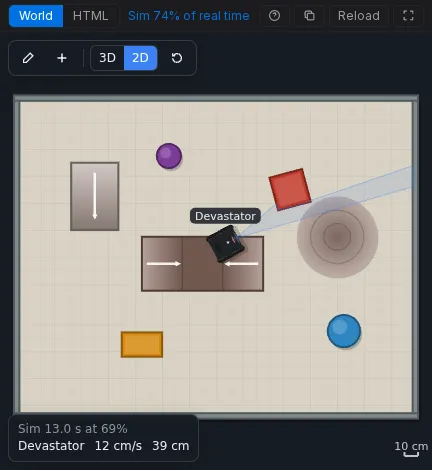
- 按 Edit(编辑),把一个箱子移到坦克的路径上,观察它扫描并转向。
- 将
loop()中的35改为20,看看它在环顾四周之前能靠近多少。 - 在电路上添加一个 MPU6050,在编辑器中将其绑定为坦克的 IMU,并在 sketch 中读取转向速率。