Velxio 2.0
Multi-Platform Embedded Simulator
Simulate Arduino, ESP32, Raspberry Pi Pico, and Raspberry Pi 3 in your browser. 19 boards, 68+ ready-to-run examples, realistic sensor simulation. Free, open-source, no install needed.
19 boards. 5 architectures. One tool.
From 8-bit AVR to quad-core ARM Linux — Velxio 2.0 emulates every major embedded platform in a single browser tab.


 XIAO C3
 C3 SuperMini
 ESP32 DevKit
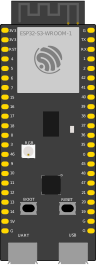 ESP32-S3
 ESP32-CAM
 Nano ESP32
 Raspberry Pi 3B
Multiple boards in one circuit
Most simulators limit you to one board at a time. Velxio lets you place multiple boards on the same canvas and wire them together — just like a real workbench.
ESP32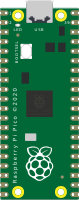 Pi Pico
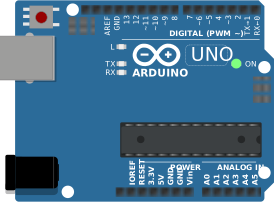 Arduino
Mix architectures
Connect an ESP32 to a Raspberry Pi 3, wire three Arduinos together, or combine a Pico with an ESP32-C3. Any combination works.
Real inter-board communication
Boards communicate through wired connections — UART, I2C, SPI, or simple GPIO signals, just like real hardware.
No other simulator does this
Traditional simulators emulate one board in isolation. Velxio simulates entire systems with multiple boards running simultaneously.
What's new in 2.0
A complete transformation into a multi-platform embedded systems simulator — more boards, more accurate emulation, better developer experience.
Multi-Board Support
- Raspberry Pi 3B — full Linux (ARM Cortex-A53 via QEMU raspi3b)
- ESP32 / ESP32-S3 / ESP32-CAM — Xtensa LX6/LX7 via QEMU
- ESP32-C3 / CH32V003 — RISC-V RV32IMC via QEMU (libqemu-riscv32)
- RP2040 — Raspberry Pi Pico / Pico W (ARM Cortex-M0+)
- ATtiny85, ATmega2560, Leonardo, Pro Mini — AVR8 via avr8js
- Multi-board canvas — mix architectures on the same simulation
Advanced Emulation
- ESP32 emulation via QEMU (Xtensa) with GPIO, ADC, timers
- SYSTIMER, timer group, and SPI flash/EXTMEM stubs
- ROM function emulation for ESP32 boot sequence
- Enhanced RP2040 dual-core ARM simulation
- Virtual File System for Raspberry Pi 3 (full Linux OS)
- Real arduino-cli compilation producing .hex / .bin / .uf2 files
Sensor Simulation
- DHT22 — accurate timing and synchronous protocol handling
- HC-SR04 — ultrasonic distance measurement with trigger/echo
- Servo motor — configurable sweep with PWM emulation
- Potentiometer and analog sensor improvements
- Generic sensor registration system for extensibility
- Improved timing accuracy and component interactions
Testing
- ESP32 test modules and integration test suites
- Multi-board integration tests across architectures
- Arduino serial communication integration testing
UI/UX Improvements
- Enhanced simulator canvas — wire handling and segment dragging
- Improved z-index layering and component rendering
- Oscilloscope and multi-board picker enhancements
- Sensor Control Panel for interactive sensor adjustment
- New visual components for all supported board families
- Mobile-first responsive design with code/circuit tab switcher
Documentation
- Full documentation site with 10+ pages
- Board gallery with all 19 supported boards
- ESP32 emulation guide (Xtensa + RISC-V)
- RP2040 and Raspberry Pi 3 documentation
- CodeBlock component with syntax highlighting
Refactoring & Cleanup
- Codebase refactors for readability and maintainability
- Removed deprecated scripts and unused code
- Simplified logging and internal data structures
Tooling & Integrations
- Discord notification workflow for issues
- Wokwi elements integrated into Landing Page visuals
- Scripts for automated example generation
- Docker standalone image published to GHCR + Docker Hub
68+ ready-to-run examples
From basic LED blink to multi-board communication — examples for every platform and skill level.
Arduino (17 examples)
Blink, traffic light, button, fade, RGB LED, Simon Says game, TFT display, LCD, I2C scanner, SPI loopback, and more.
Raspberry Pi Pico (18 examples)
Blink, serial, I2C (scanner, RTC, EEPROM), SPI, ADC read, DHT22, HC-SR04, servo, joystick, NTC sensor.
ESP32 (9 examples)
Blink, serial echo, 7-segment, DHT22, HC-SR04, MPU6050 IMU, PIR motion, servo, joystick.
ESP32-C3 RISC-V (9 examples)
Blink, serial, RGB LED, button + LED, serial echo, DHT22, HC-SR04, PIR, servo.
Arduino Mega (5 examples)
Blink, LED chase, serial echo, serial control, 7-segment display.
Arduino Nano (4 examples)
Blink, button LED, fade, serial echo. Plus multi-board Pi-to-Arduino control.
The outcome
Velxio 2.0 transforms the project into a complete, scalable multi-platform embedded systems simulator.
More realistic emulation
QEMU-based Xtensa, RISC-V and ARM emulation. Cycle-accurate AVR8 via avr8js. Real firmware execution, not approximations.
Broader hardware support
19 boards across 5 CPU architectures. From 8-bit ATtiny85 to quad-core Raspberry Pi 3B running full Linux.
Better developer experience
Monaco editor, multi-file workspace, library manager, oscilloscope, sensor control panel, mobile-responsive design.
Built on open-source
Velxio is powered by these open-source projects. Without them, none of this would be possible.
avr8js
AVR8 CPU emulator in JavaScript — powers Arduino Uno, Nano, Mega simulation
rp2040js
RP2040 emulator — powers Raspberry Pi Pico and Pico W simulation
wokwi-elements
Web Components for electronic parts — LEDs, buttons, sensors, displays, and more
wokwi-boards
SVG board definitions for Arduino, ESP32, Raspberry Pi Pico, and other boards
QEMU (lcgamboa fork)
QEMU fork with ESP32 Xtensa LX6/LX7 emulation support
QEMU (Espressif)
Official Espressif QEMU fork for ESP32 development and testing
wokwi-features
Feature tracking and component specifications for the Wokwi ecosystem
Velxio
This project — free, open-source multi-board embedded simulator
Try Velxio 2.0 now
Open the editor and start simulating — 19 boards, 68+ examples, zero setup.
Launch Simulator